Tempest
Introduction
Tempest is a computational laboratory for simulating and studying PDE-based systems. It hosts a variety of PDEs and numerical methods.
However, it did not start out with this vision. I'm writing this to gain insight into the evolution of Tempest since its inception and what I've learnt along the way.
The beginning
At the end of my first year, I grew fascinated with Numerical Weather Prediction. The fact that even state of the art models hit a hard mathematical wall beyond 10-14 days really got me thinking about this field. The chaotic nature of the atmosphere was almost entrancing and too interesting to ignore.
So, there I was. An 18-year old trying to build an entire NWP model. I quickly realised I had to start small. Very small. The first commit was literally just the 1D linear advection with Euler integration.
Initial Design
The entire code was, and still is, written in Python from scratch using NumPy with a simple Matplotlib dashboard.
The initial design wasn't a planned out architecture. I was just focused on getting an output.
Learning numerical methods
I evolved the project incrementally, adding one PDE, integration method, boundary condition at a time.
I learnt how numerical solvers actually work by discretization and how they're actually just an approximation.
How boundary conditions work using ghost cells, and a lot of foundations of grid-based numerical simulations.
Validation
Then one day I though: "Wait a minute, how do I know my simulations are correct?". That led me down the rabbit hole of validation and convergence studies.
Automated data generation, validation studies, convergence plots, boundary mismatch, numerical error.
It was a steep learning curve to actually implement analytical solutions and learn where that error term comes from in the numerical expansion.
A thing that drove me crazy was the boundary conditions. Analytical solutions always assume infinite domains but that isn't always the case in simulations.
Another setback was with shock-based PDEs like Burgers' and Shallow Water equations. With low-order finite-difference and finite-volume schemes, the diffusive and dispersive effects made it extremely hard to validate.
Generalized structure
While validating my engine, I thought about what my now scientifically accurate framework can actually do. I realized that a truly generalized architecture could eventually support any PDE, integration method, operator, or dimension. This should be the selling point of Tempest.
A generalized architecture could span use-cases from turbulence research to NWP. Not just limited to fluid phenomena, it could simulate electromagnetism and literally any system governed by PDEs.
So, I started working on a generalized framework. Each module independent of others with no implicit assumptions.
This was probably the single most important architectural leap. Tempest evolved from a PDE solver to a research framework.
Scientific Machine Learning
It was at this point that I started researching about scientific machine learning. The concept of a surrogate really stood out to me.
So, I implemented one from scratch. A lightweight physics-informed CNN to predict the linear advection equation. Worked surprisingly well for such a simple model, but I wanted to explore further.
I explored spectral methods such as the Fourier Neural Operator. It was really fun learning about the Fourier transform and how states are represented in the Fourier space.
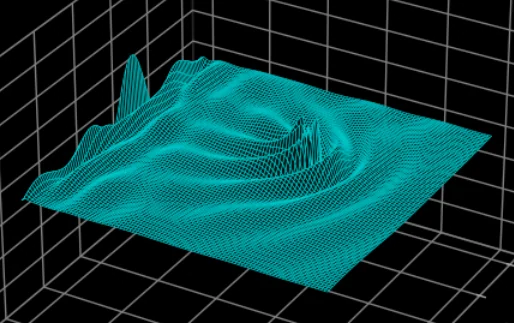
2D extension
This was a feature pending for a while. Didn't take long because of the already implemented generalized architecture.
What came with it was a beautiful dashboard and even more beautiful visuals.
Looking back
Tempest has come a long way. From just the linear advection to a potential research-grade framework as I had hoped.
I think the best thing about Tempest is its modular and generalized architecture. Implementing a new PDE just requires you to write its equation and nothing else.
The next steps are to build on this foundation to explore complex, exciting concepts.
Things that surprised me
A lot of things were very different from what I expected
- Writing numerical equations and operators was easier than validating them
- Boundary conditions were harder than the PDEs itself
- Visualization became an important debugging tool rather than a cool feature
- Scientific computing relies heavily on validation and confidence rather than core implementation
What Tempest taught me
Scientific computing is all about confidence.
Confidence that the mathematics has been translated correctly.
Confidence that the implementation behaves as expected.
Confidence that numerical errors are understood rather than ignored.
Everything builds upon this confidence.
More importantly, it taught me how to think about scientific computing itself. Concepts like modularity, convergence, reproducibility have dictated every project I've built since.
If I Started Again Tomorrow
Without a doubt, I'd focus on modularity, extensibility, and fidelity.
This has been my approach toward all my future projects and I think Tempest was the best learning platform for that.
Stepping back
I haven't touched Tempest in a while now. Not because something broke or the ideas ran dry, just because my attention moved elsewhere. Math, deep learning, interpretability, quantum computing.
So yeah, Tempest is done, for now at least.
Looking back, I don't think it ever really became the "research-grade framework" I hoped it would. What it actually was, was a sandbox. A place to just build things and see if they broke. Discretization, convergence, boundary conditions, surrogates. I didn't learn any of this from a textbook, I learnt it by getting it wrong first and then figuring out why.
The CNN-PINN, the Fourier neural operator, all of it taught me way more about how to approach a problem than about the specific equations I was solving.
Tempest doesn't need to keep growing for any of that to count.